Navigation for Humanity's Next Frontier.
AI-powered autonomous navigation for lunar landers, rovers and orbital missions.
Trusted architecture for the next generation of space exploration.
"Imagine driving a car at 300 km/h, blindfolded, with a 1.3-second delay between your eyes and your brain. That is how every lunar lander operates today."
At CompassX, we believe space exploration shouldn't be a gamble. It should be a calculated, safe and autonomous journey. We are building the software that turns the Moon from a cosmic nightmare into a mapped, navigable destination.
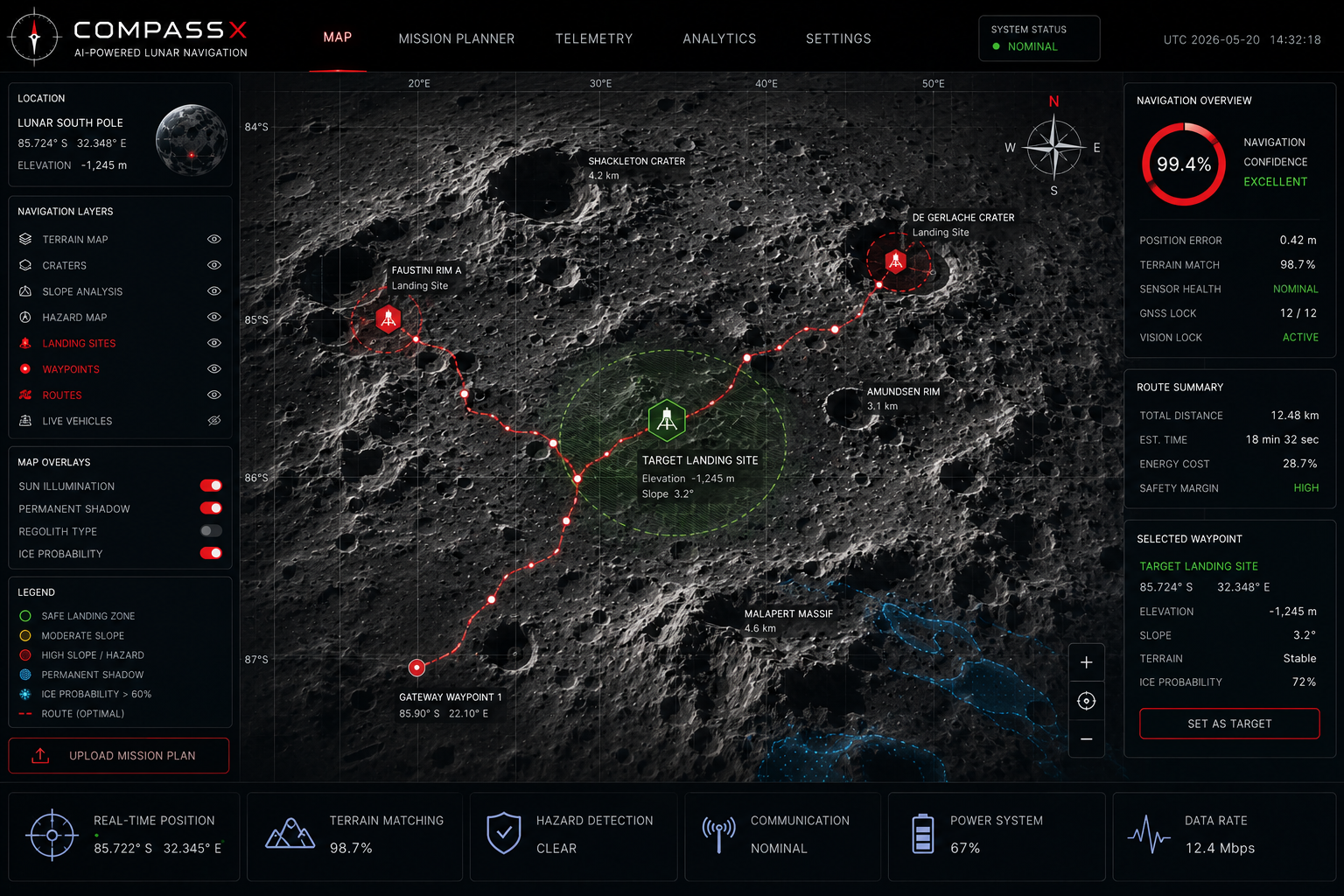
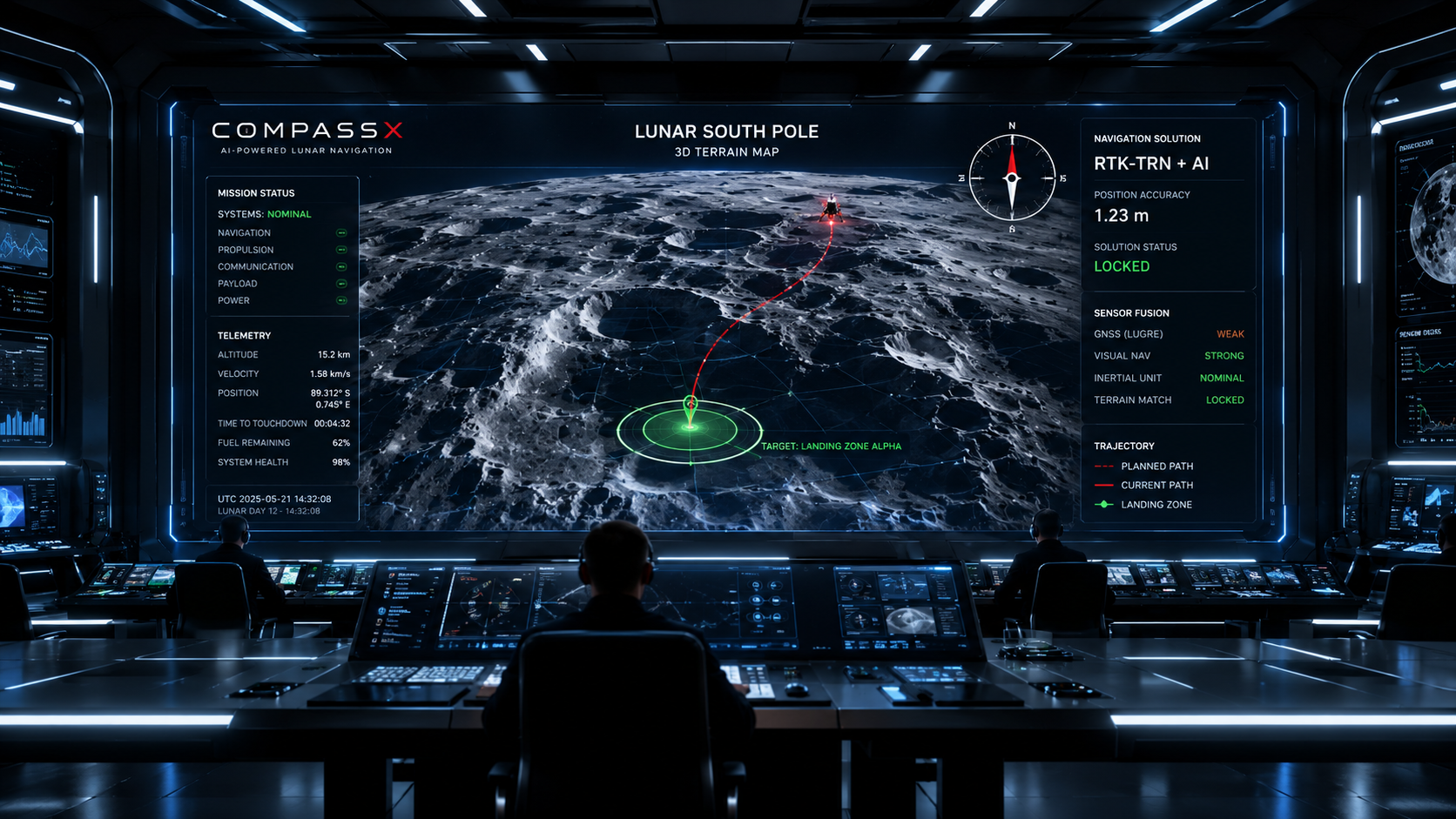
A safe landing zone, computed in real time.
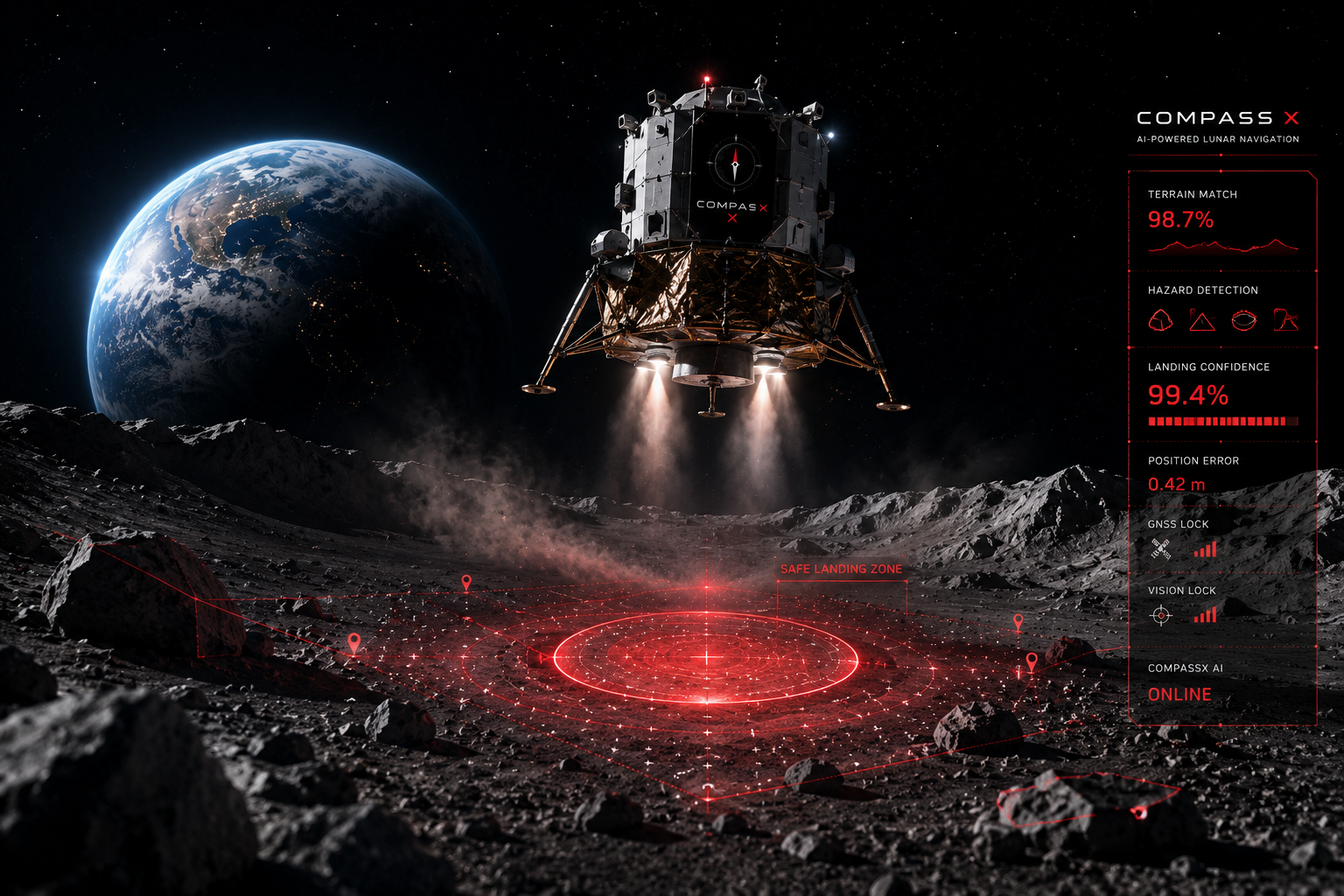
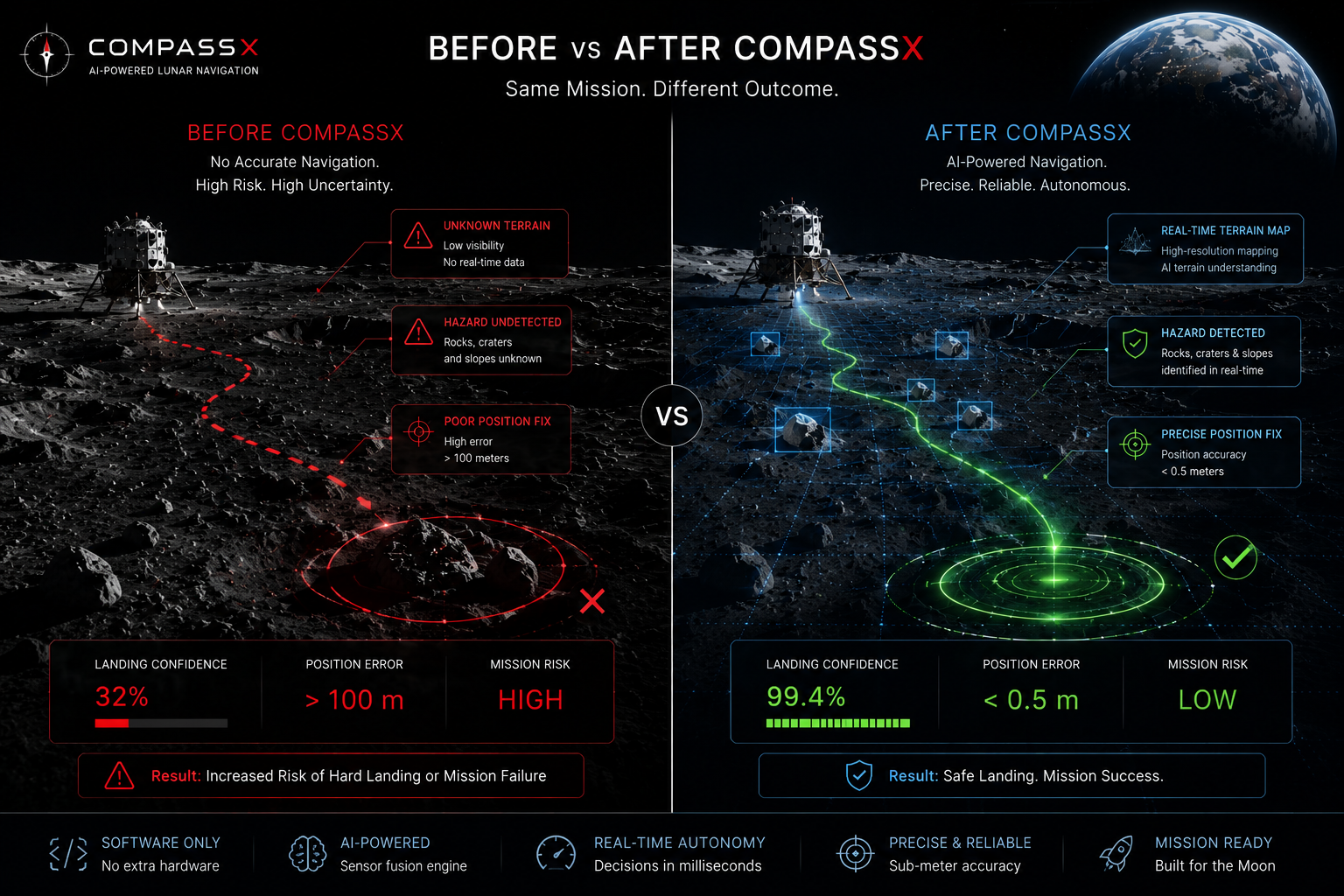
Terrain match at 98.7%, position error of 0.42m, landing confidence of 99.4% — CompassX narrows an entire crater field down to one verified safe landing zone, live, without waiting on Earth.
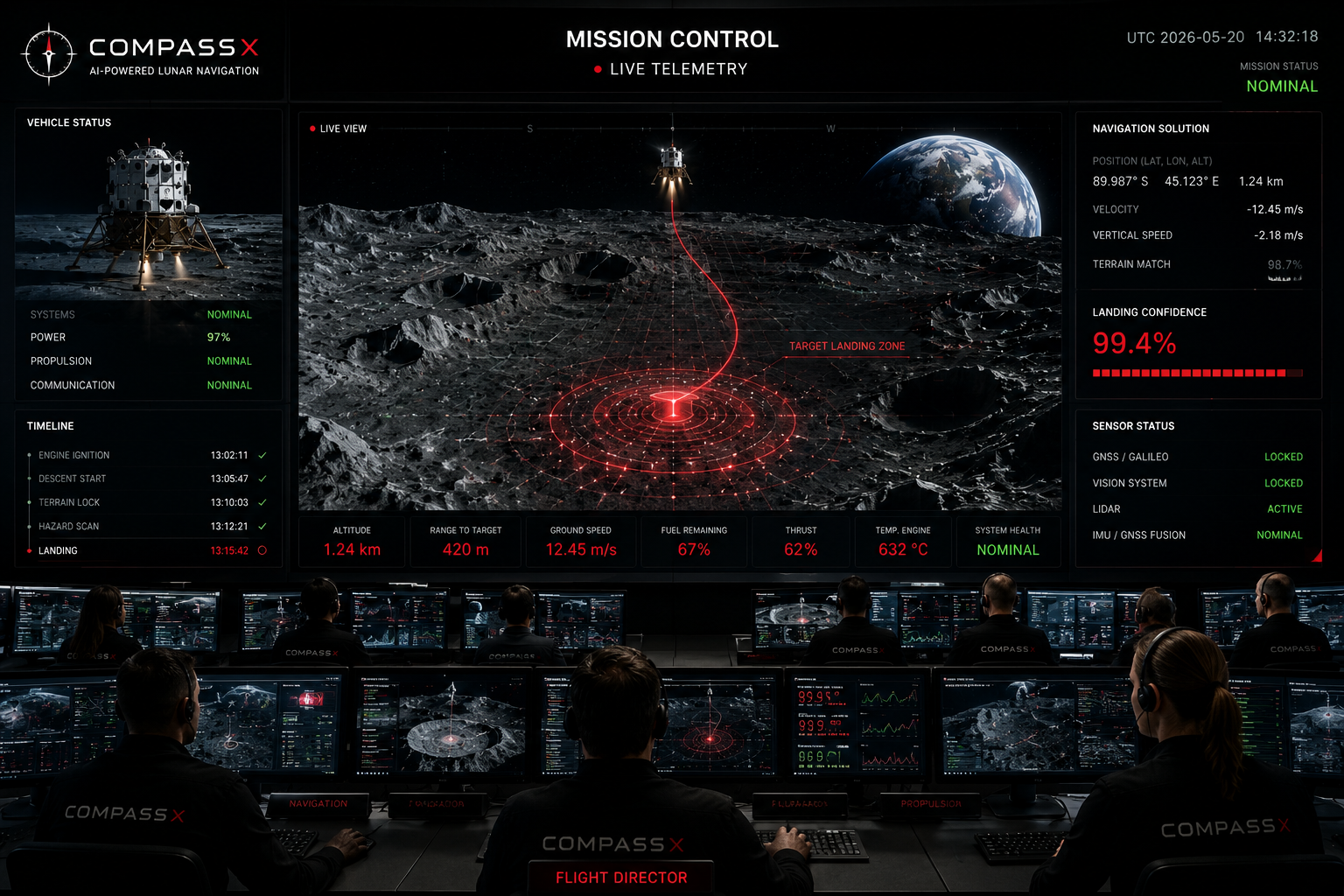
Every descent is watched live: navigation solution, sensor status and landing confidence, tracked second by second until touchdown.
"The Moon is not the destination.
It is humanity's next operating system."
The Void: No GPS. No Signs. No Second Chances.
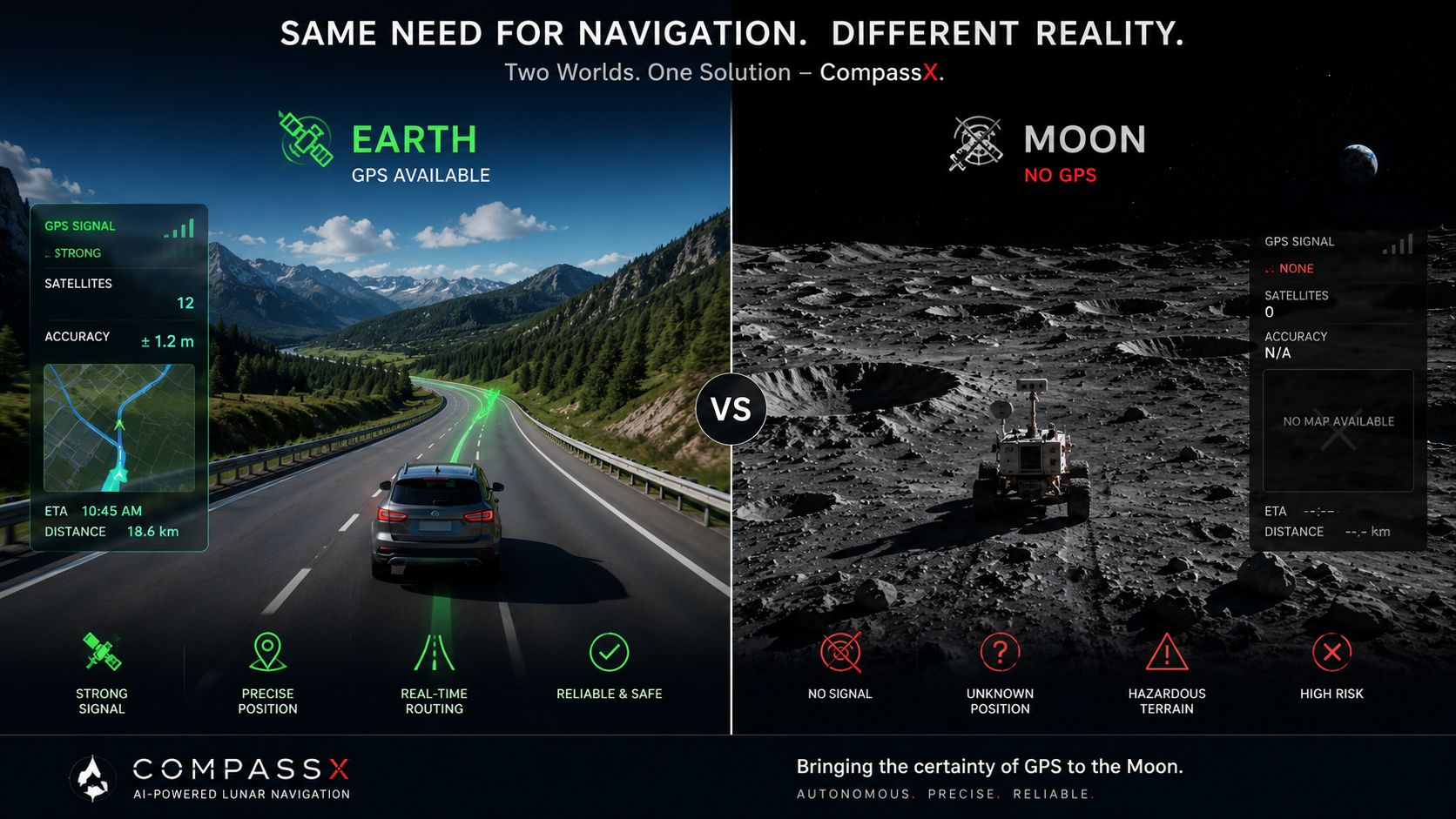
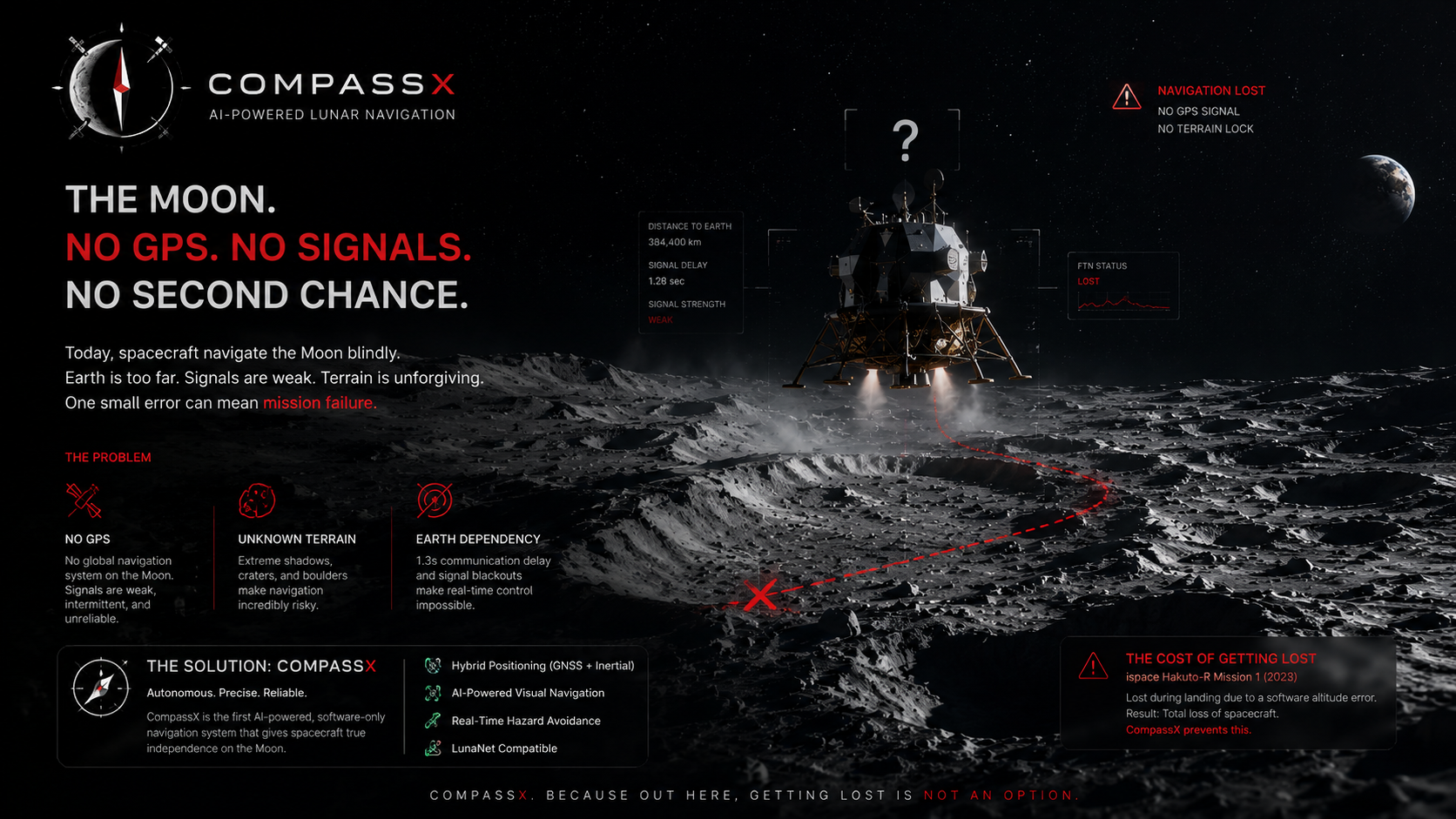
When you look at the Moon, you see a beautiful silvery disk. But when a spacecraft looks at it, it sees a silent, indifferent void. There are no street signs. No traffic lights. No satellites broadcasting "turn left in 100 meters."
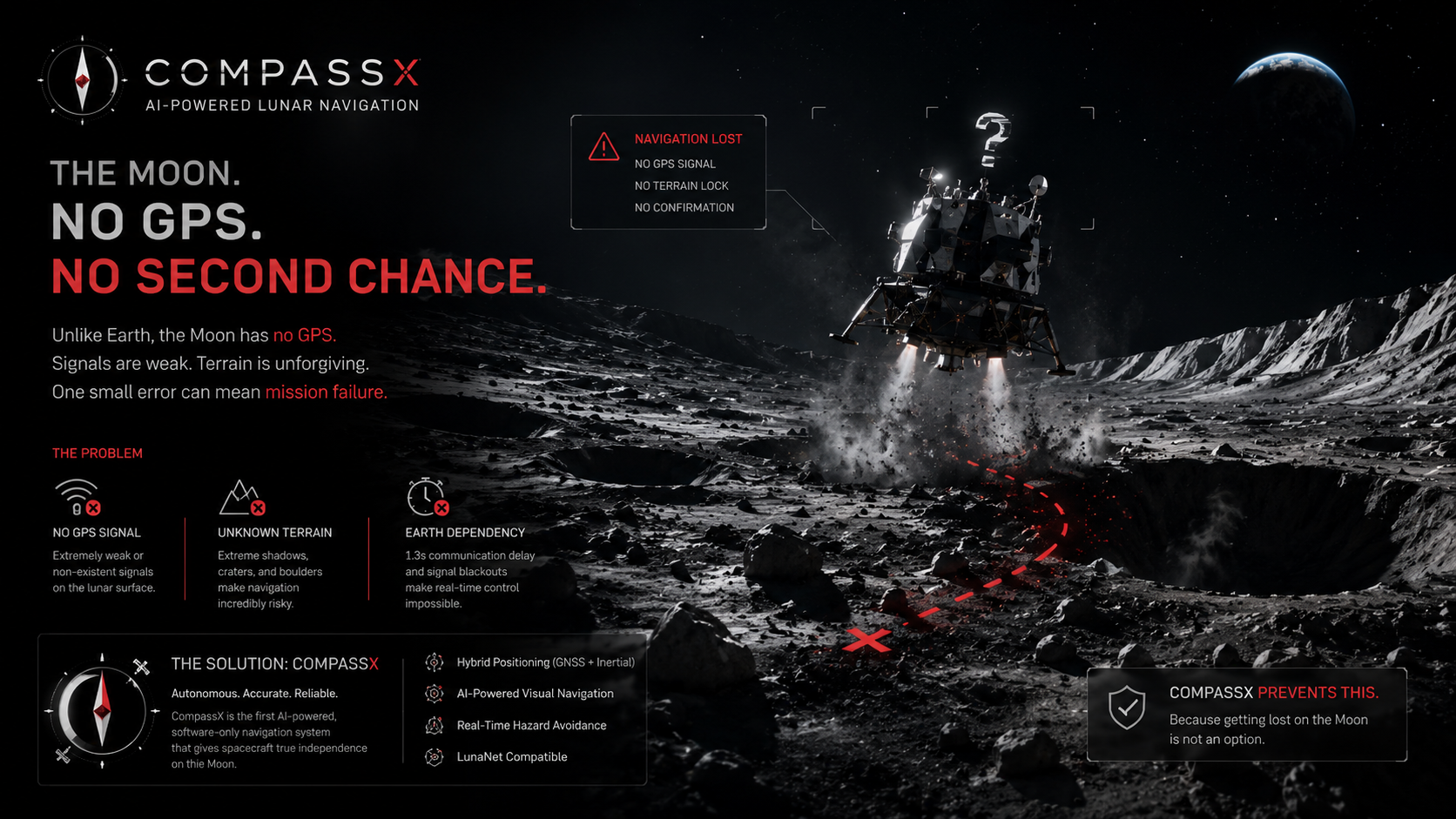
Lunar missions rely on the Deep Space Network — giant antennas on Earth shouting commands into the void. It takes 1.3 seconds for a signal to reach the Moon. By the time a lander receives permission to adjust its course, it has already traveled over a kilometer. This is why ispace's Hakuto-R crashed in 2023 — a software error in altitude estimation, a mistake an autonomous system could have caught, turned a $200M dream into a crater.
With over 250 missions planned in the next decade, we cannot afford to navigate the Moon like the Apollo era. We need a modern system. We need a digital brain on board. We need CompassX.
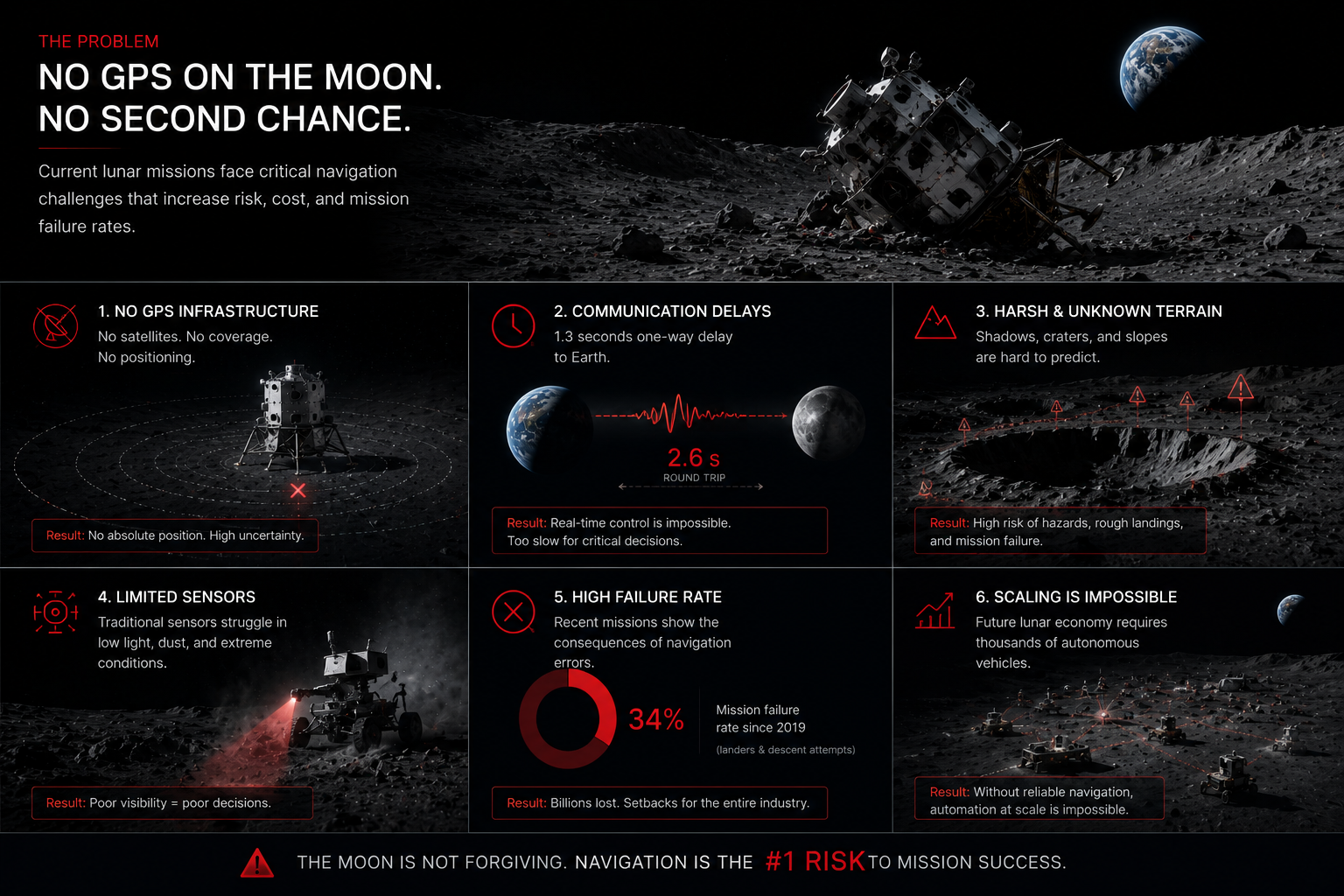
Since 2019, lunar landers and descent attempts have failed at a 34% rate — and every one of those failures traces back to the same six compounding gaps: no GPS infrastructure, a 2.6-second round-trip communication delay, unpredictable shadowed terrain, sensors that struggle in low light and dust, the resulting high failure rate itself, and the hard ceiling it puts on scale. You cannot fly thousands of autonomous vehicles on the Moon without solving all six at once — which is exactly what CompassX is built to do.
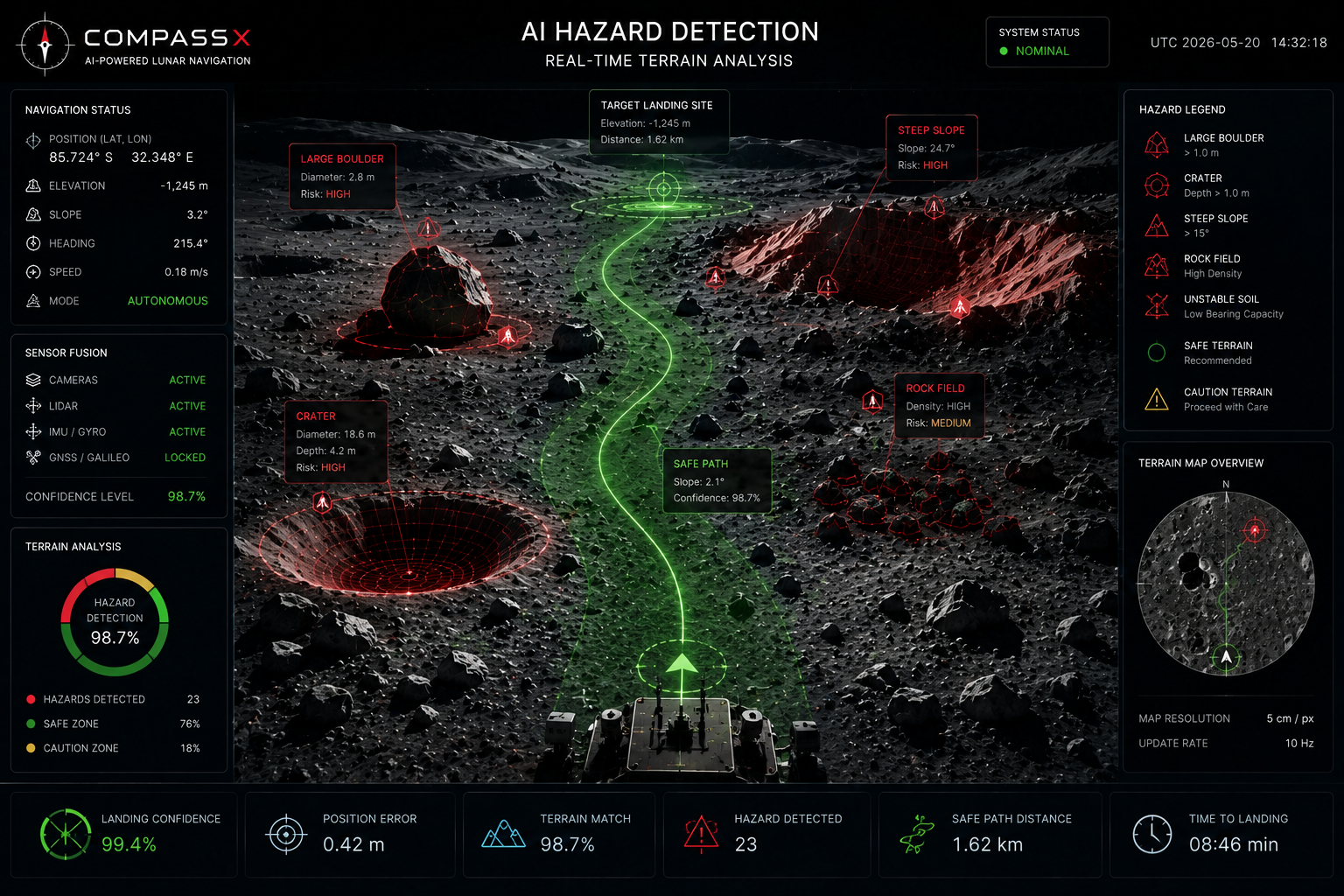
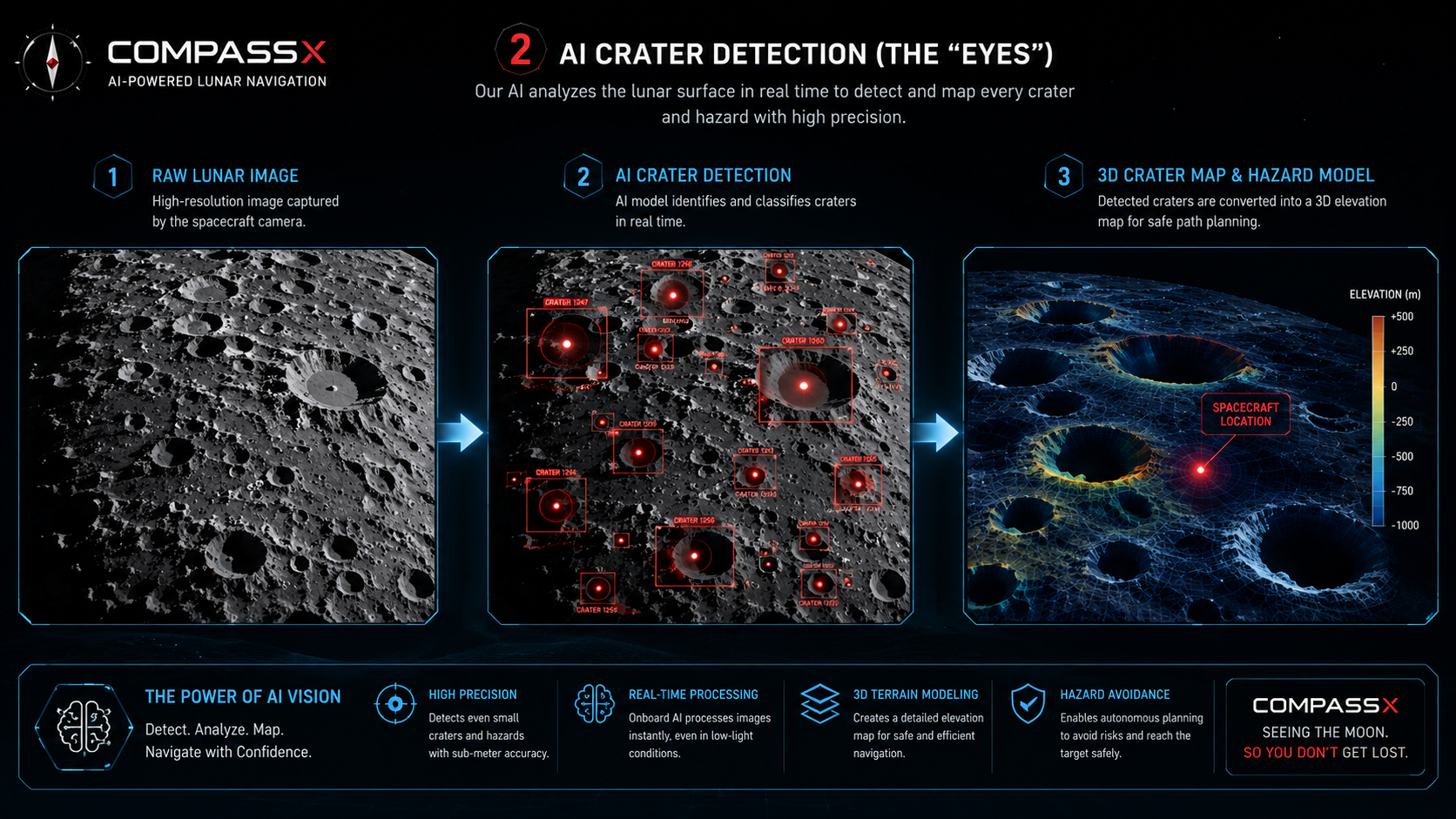
This is what solving the problem looks like: CompassX's AI scans the terrain ahead in real time, flagging every boulder, crater, steep slope and rock field by risk level, then plots a safe path around them — landing confidence 99.4%, hazard detection 98.7%, position error down to 0.42m. The Moon stops being a guess and becomes a mapped, navigable surface.
Drag to compare: unmapped surface vs. AI hazard detection.
See It. Map It. Land It.
We don't build rockets. We build the brain that makes rockets smart — a purely software-based navigation engine that runs directly on the spacecraft's flight computer.
"We are not just building a map. We are building the standard for the future of spaceflight."
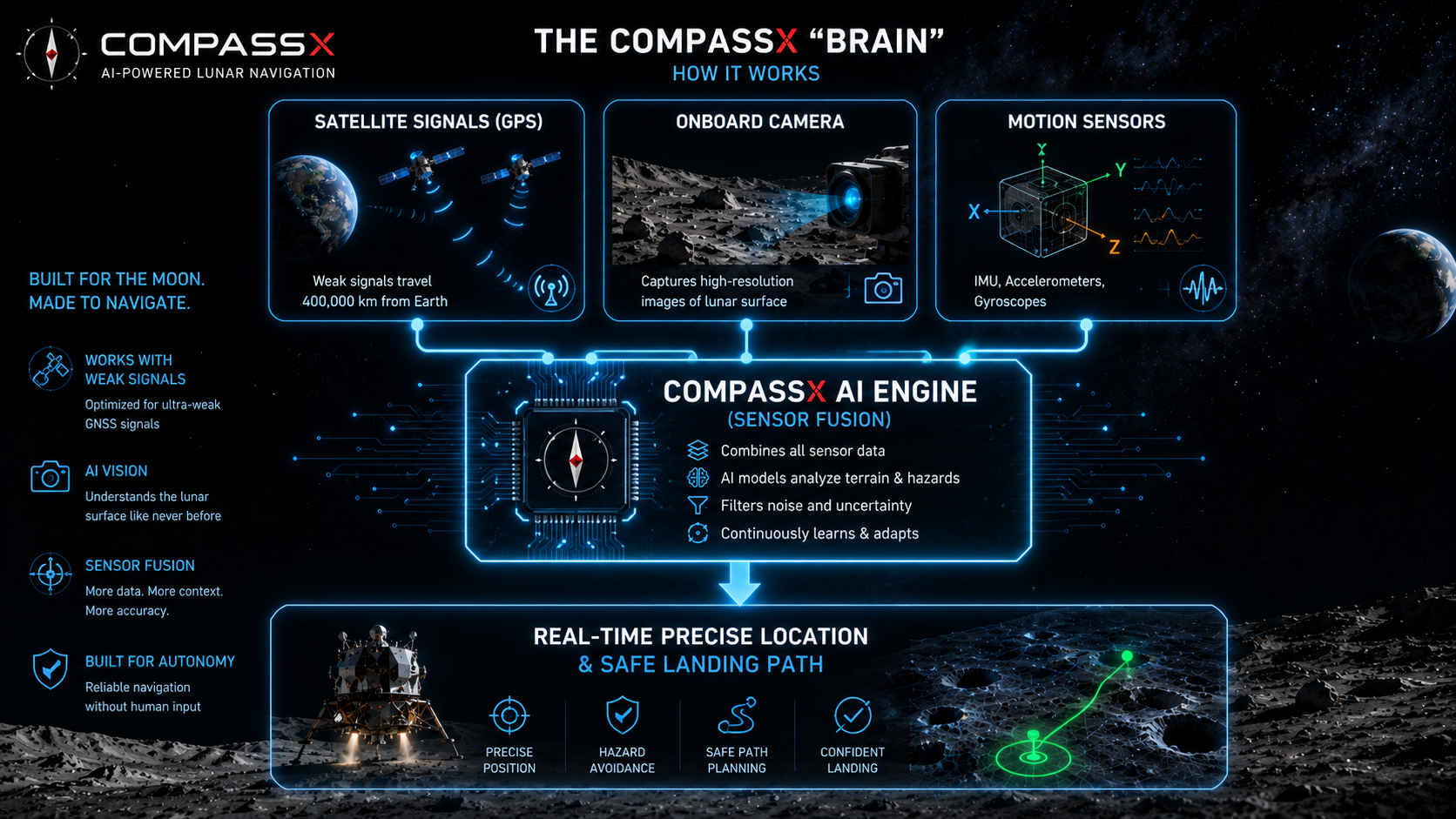
Five sensor inputs. One fused decision.
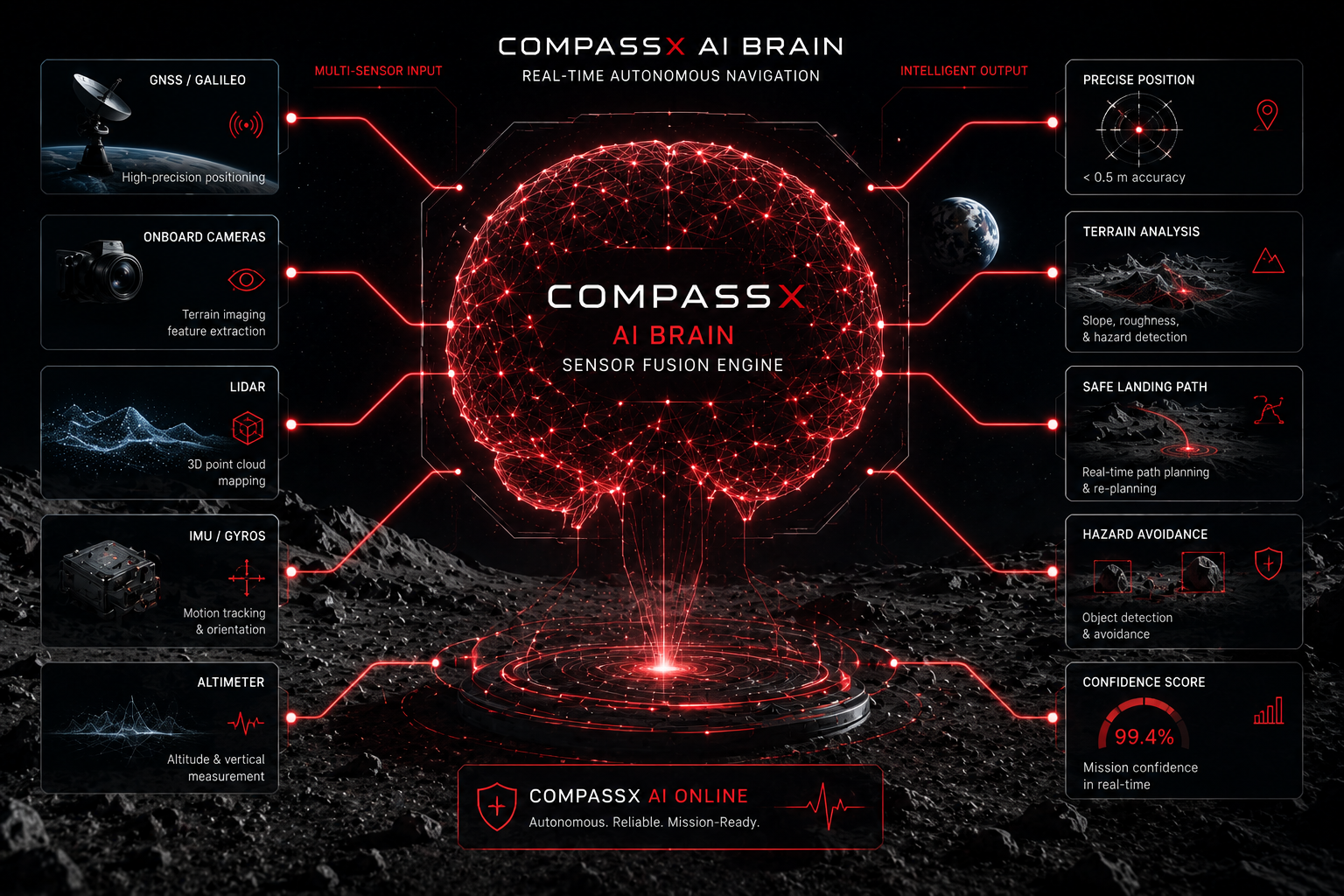
GNSS/Galileo, onboard cameras, LiDAR, IMU/gyros and an altimeter all feed the same engine — which outputs precise position (<0.5m), full terrain analysis, a safe landing path, real-time hazard avoidance, and a live 99.4% confidence score.
The same brain drives rovers, not just landers.
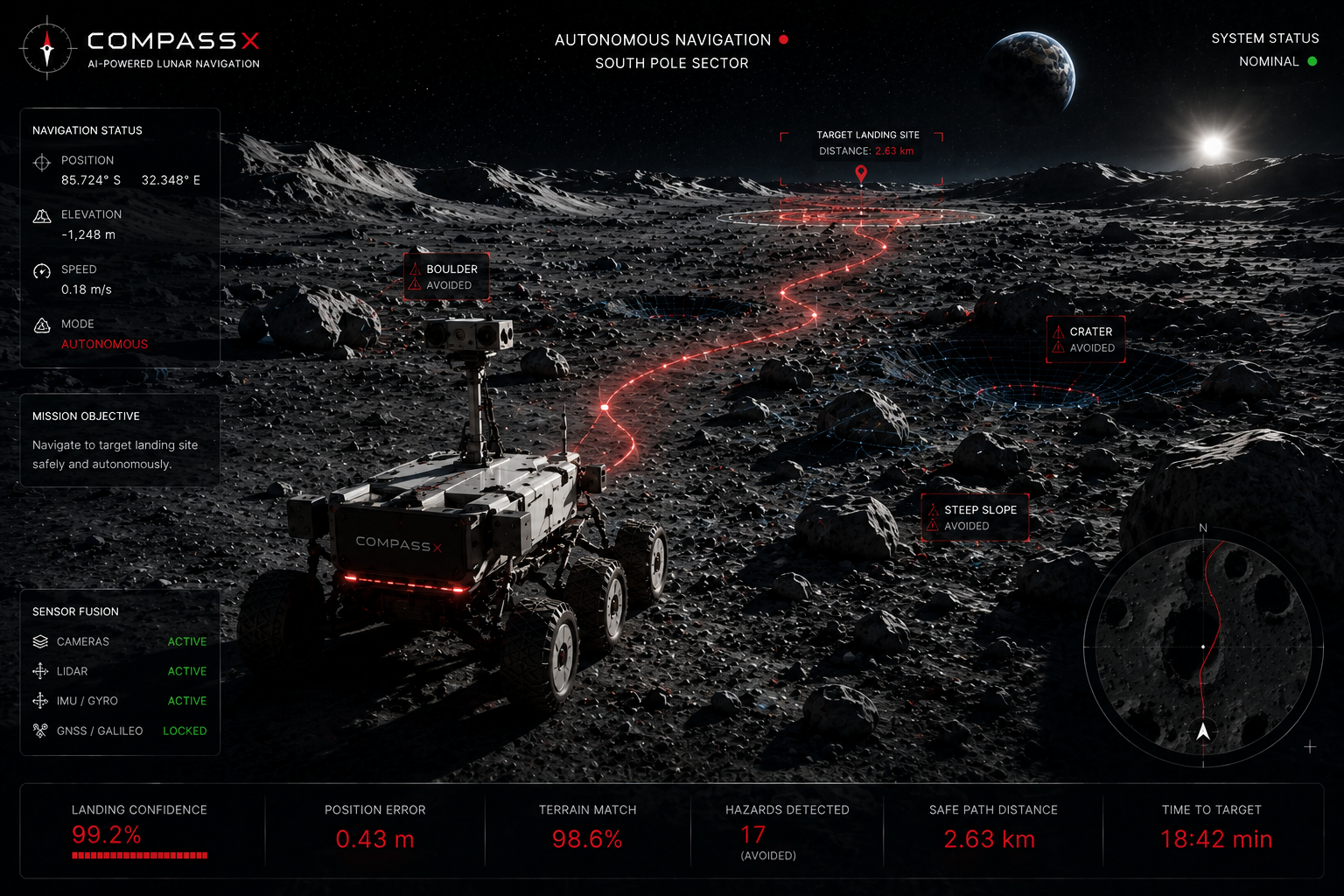
In the South Pole Sector, the same sensor-fusion engine steers a rover around a boulder, a crater and a steep slope in real time — 17 hazards avoided, 98.6% terrain match, 99.2% landing confidence, no command from Earth required.
Zoom in. Click a landing site.
The same console mission teams use — terrain, hazards, illumination, ice probability and routes, live.
The New Space Economy Depends on Us.
The Moon is the new frontier for commerce, science and geopolitics. Governments like NASA and ESA are racing to establish permanent bases; commercial giants like Firefly Aerospace and Intuitive Machines are building the infrastructure; emerging players are planning to mine water ice and rare minerals. None of them can succeed without autonomous navigation — to land precisely near valuable resources at the dangerous, shadowy poles, move rovers safely across treacherous terrain, or dock autonomously without risking catastrophic collisions.
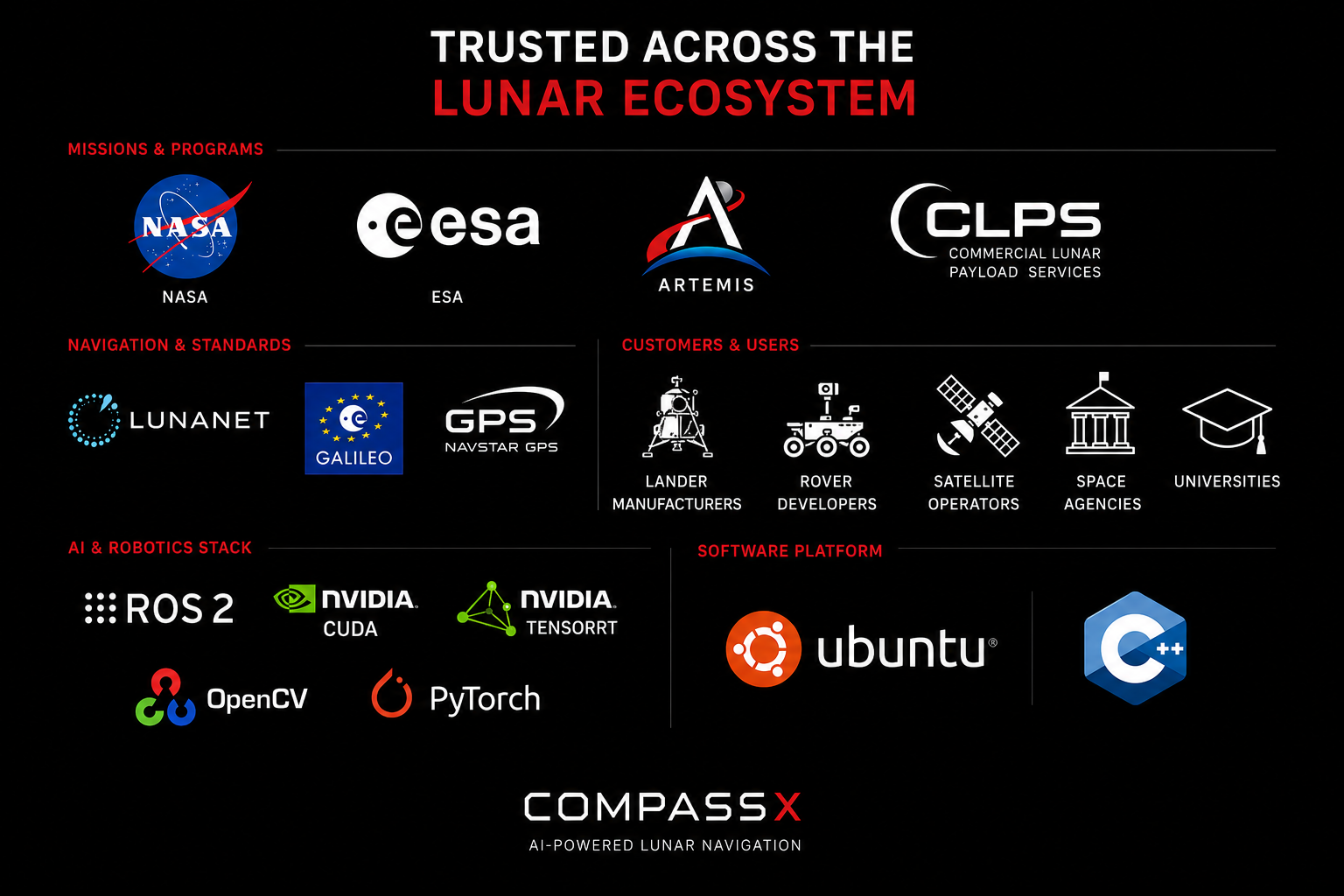
One Platform. Every Mission.
CompassX ships as a subscription: cloud dashboard, API access, live map updates and mission support — no hardware to integrate.
Before You Reach Out.
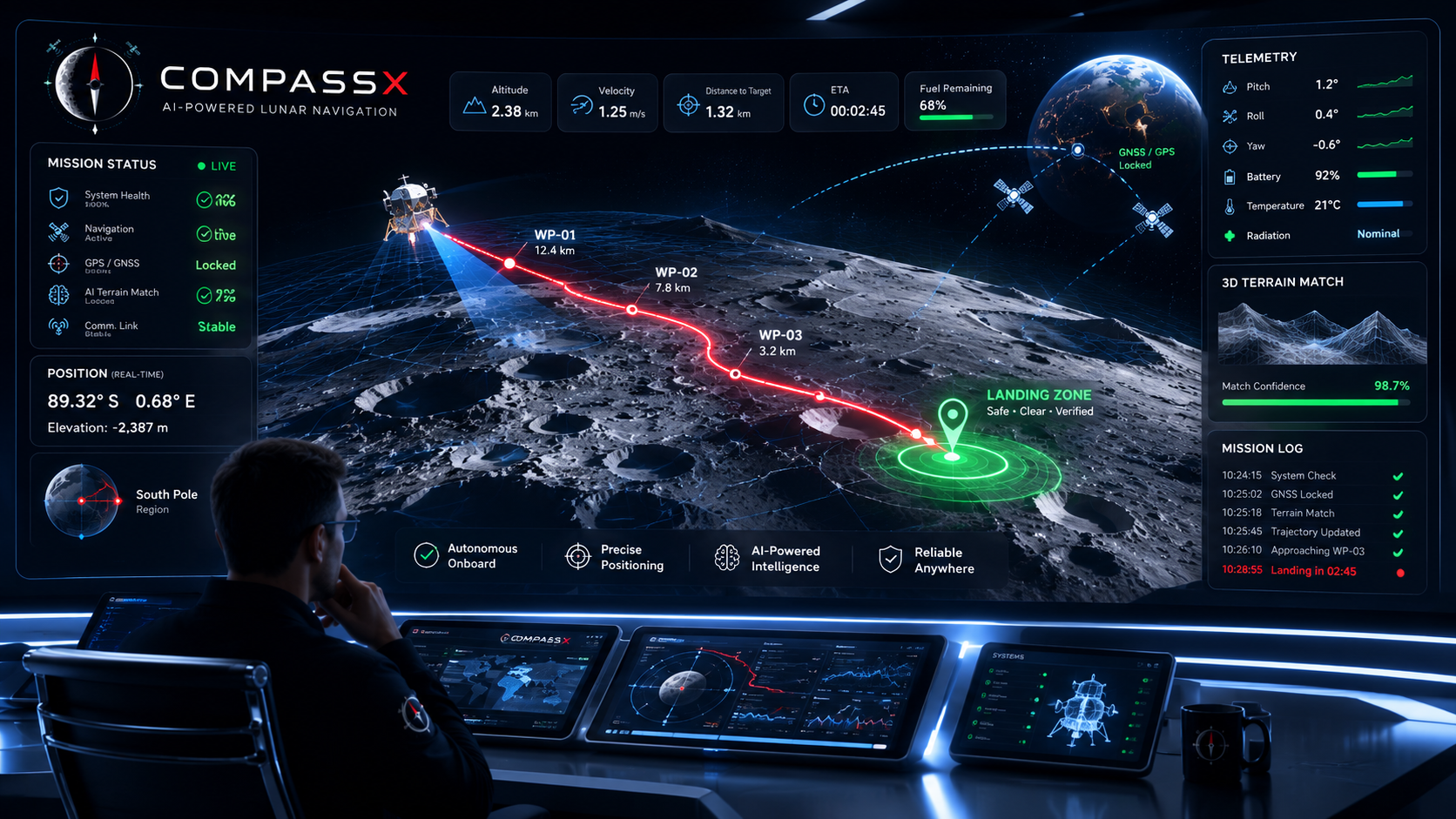
One dashboard: map, mission planner, telemetry.
Mission teams get the whole picture in one subscription: the terrain and hazard map, planned route and waypoints, and live navigation confidence — updated in real time, from any browser.
Built in Switzerland. Powered by Precision. Guided by Passion.
CompassX was born in the heart of the Swiss Alps, where precision isn't just a virtue — it's a law. Switzerland gave us neutrality, allowing us to bridge geopolitical divides. It gave us access to the world's best universities, like ETH Zürich, home of the MoonWalker rover project, and proximity to the European Space Agency.
We believe that space should be accessible to all nations, not just superpowers. We believe that safety should not be a luxury, but a baseline. We are CompassX. We are charting the path to the stars.

Ahmed Al Sultan is the Founder and CEO of CompassX, a Swiss deep-tech company building autonomous navigation software for the next generation of lunar exploration. With a background in product management, artificial intelligence, cybersecurity, and entrepreneurship, he combines commercial strategy with advanced technology to solve one of the most fundamental challenges of the new space economy: reliable navigation beyond Earth.
His vision is to build the software infrastructure that enables every lunar lander, rover, and autonomous mission to navigate the Moon with the same confidence that GPS provides on Earth. From Lausanne, Switzerland, Ahmed is building CompassX to become a key contributor to Europe's future in space.
Precision has an address.
CompassX is proudly based in Lausanne, Switzerland, one of Europe's fastest-growing deep-tech ecosystems.
Located near EPFL, ESA partners and world-leading AI laboratories, CompassX combines Swiss engineering, precision and reliability with cutting-edge artificial intelligence.
Apollo proved humans could reach the Moon. CompassX exists to prove they can stay — safely, repeatedly, autonomously.
Every prior landing built its own navigation from zero, at enormous cost and risk. We started CompassX because the next decade of lunar missions — 250 and counting — cannot each re-solve the same problem. The Moon needs the same thing the automobile needed in the 20th century: a map, and a system you can trust to read it.
Switzerland gave us the neutrality to build for every agency, not one. ETH Zürich gave us the science. What's left is the work: turning autonomous lunar navigation from a research problem into infrastructure.
Before humans could explore Earth…
we built maps.
Before we could navigate oceans…
we built the compass.
Before billions of people could travel confidently…
we built GPS.
Now humanity is returning to the Moon.
CompassX builds what comes next.
The navigation layer for a new world.
Why This Story Started.
"1969, Apollo astronauts landed with human guidance. In 2026, robotic missions still depend on Earth. By 2035, thousands of autonomous vehicles will explore the Moon — CompassX exists to become the navigation layer that enables that future."
— Ahmed Al Sultan, Founder & CEO. Read more on the About page.
The Journey So Far.
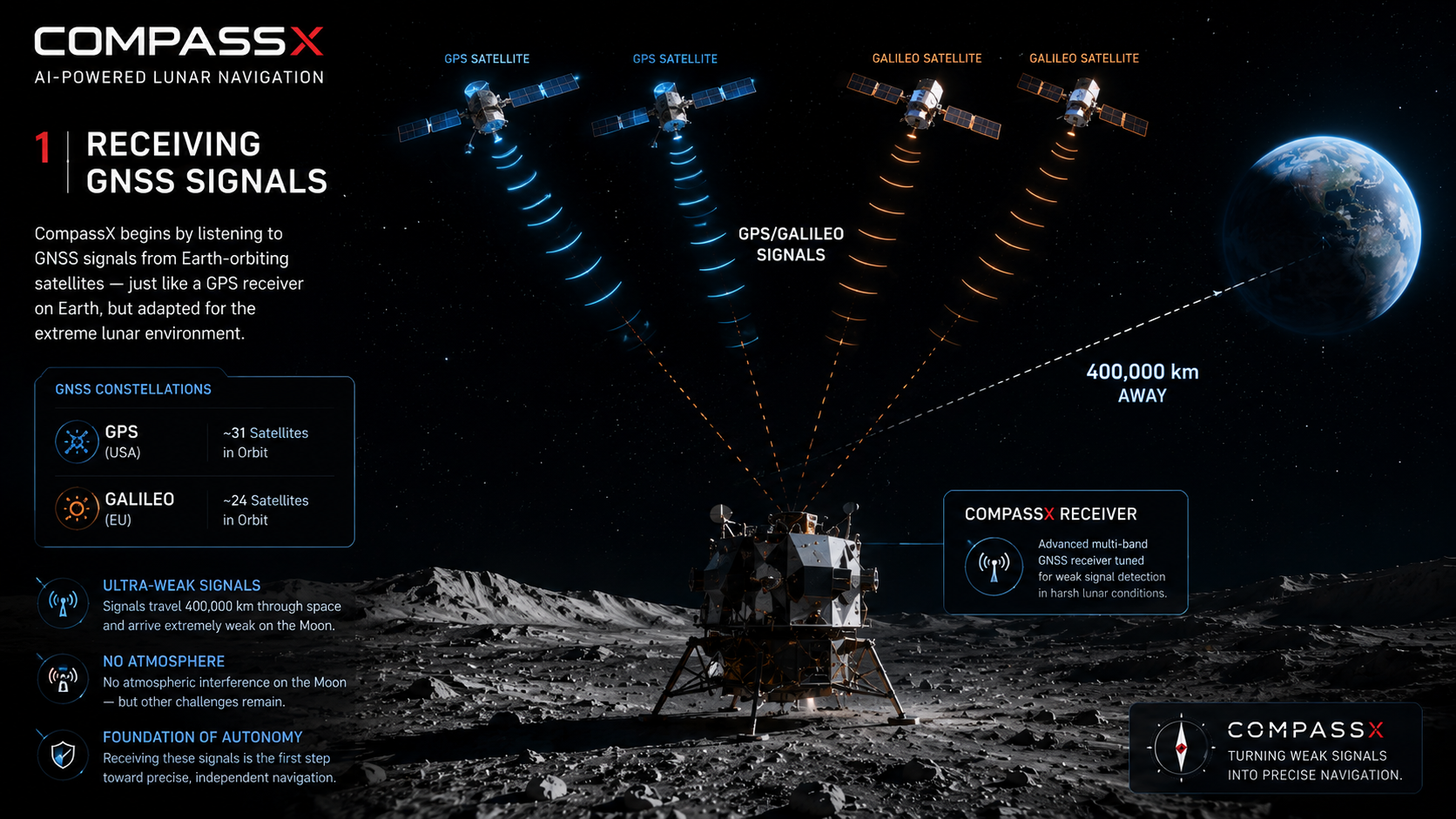

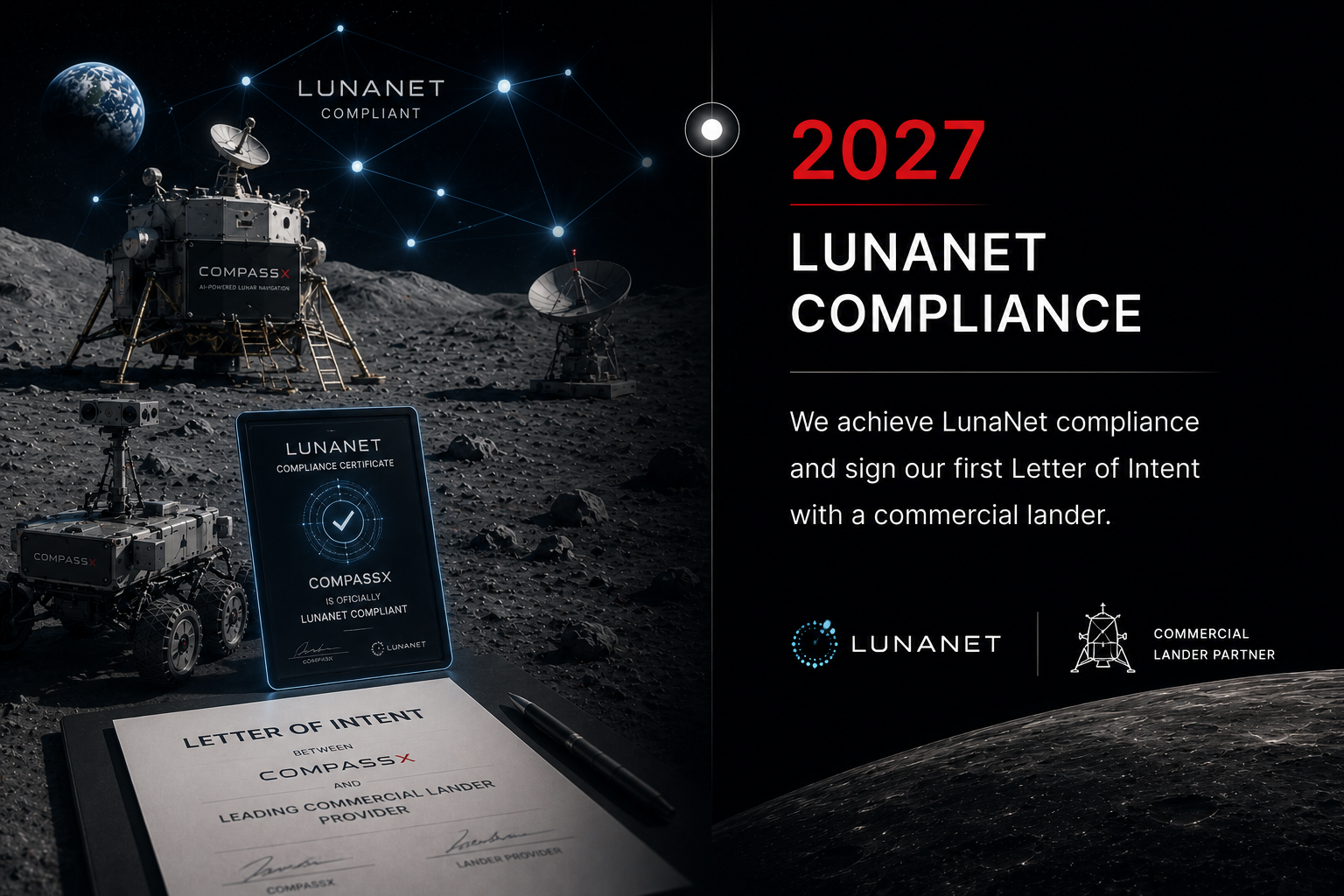
One system. Every benefit. A new economy.
CompassX turns the Moon from an unmapped hazard into navigable territory — the same certainty GPS gave cars, ships and planes on Earth, delivered to lunar landers, rovers and orbiters. That single capability compounds into real, measurable benefits for every mission that carries it.
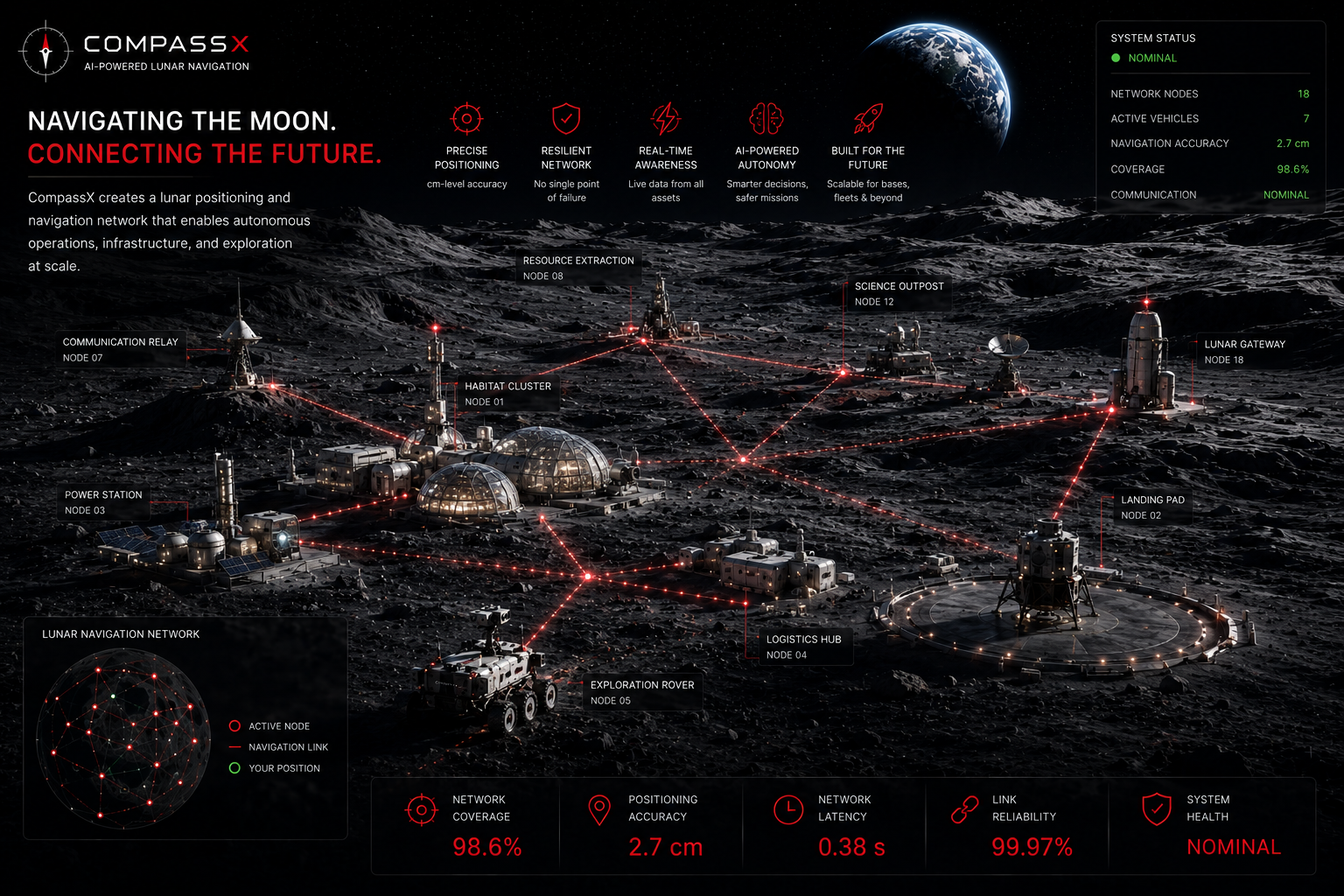
Every node routes through the same navigation core — one shared standard, not a patchwork of one-off systems.
Navigation is the layer the whole lunar economy sits on.
Every dollar of the $8.7B lunar navigation market, and every mission behind the 250+ planned in the next decade, depends on the same unsolved problem: knowing exactly where a spacecraft is and where it's safe to go. CompassX supplies that layer as software, not infrastructure — which means the economics compound rather than compete.
Reliable navigation is what turns one-off missions into a repeatable industry: mining operators can commit capital to water-ice extraction at the poles, commercial landers can insure their payloads at lower premiums, and government programs can share one interoperable standard instead of funding redundant systems. As a Swiss, neutral supplier, CompassX can sell that standard to every agency and company building toward the Moon — accelerating the entire sector instead of one flag.
The before/after is the whole business case in two numbers: landing confidence goes from 32% without CompassX to 99.4% with it, and position error drops from over 100m to under 0.5m. At mission scale, that's the difference between a lunar economy that stays a handful of one-off flights, and one where a network of habitats, landing pads, power stations and science outposts — 18 nodes and counting — can be built, resupplied and operated with confidence.
In short: fewer crashes, cheaper missions, faster timelines, and a shared standard everyone can build on — that is CompassX's contribution to the new space economy.
Invest in the Navigation Layer for the Moon.
CompassX is raising to take our navigation software from prototype to flight-qualified — ahead of the wave of 250+ lunar missions planned over the next decade. All figures below are illustrative and will be finalized with counsel and our lead investor before close.
Founded and led by Ahmed Al Sultan, backed by a growing Swiss deep-tech team with ties to ETH Zürich. Full bios on the About page.
Drive the Rover. Find the Landing Zone.
Use arrow keys / WASD to steer. Somewhere ahead is unstable, cratered terrain — geologically unsuitable for landing. Without navigation aid, you won't see it coming. Flip on CompassX to see why that changes everything.
Ready to Navigate the Future?
The Moon is calling. Whether you are planning a mission, building a rover, or investing in the next giant leap — we are looking for partners to join us. Don't just watch the stars. Chart them.
1015 Lausanne, Switzerland
Latest from CompassX.
Help Build the Moon's Navigation Layer.
We're a small Swiss team working on one of the hardest open problems in the new space economy. If autonomous navigation, computer vision or flight software excites you, we want to hear from you.
Don't see your role? Reach out anyway — careers@compassx.ch
Privacy Policy
CompassX AG ("we") is committed to protecting the privacy of visitors to compassx.ch and users of our services, in accordance with the Swiss Federal Act on Data Protection (nFADP) and, where applicable, the EU General Data Protection Regulation (GDPR).
We collect only the information you provide through our contact form (name, email, company, message) to respond to your inquiry, and aggregate, non-identifying analytics to understand site usage. We do not sell personal data to third parties.
To exercise your rights of access, correction or deletion of your data, contact us at contact@compassx.ch. This is placeholder policy text — replace with counsel-reviewed language before launch.
Terms of Use
By accessing compassx.ch, you agree to use this site for lawful, informational purposes only. Content describing CompassX's technology, roadmap and market data reflects our current plans and estimates, and does not constitute a binding commitment, investment advice, or a guarantee of mission outcomes.
All trademarks, logos and content on this site are the property of CompassX AG unless otherwise noted, and may not be reproduced without permission.
This is placeholder terms text — replace with counsel-reviewed language before launch.